Getting Around Manchester: The Complete Transport Guide
Trams, buses, trains, cycling, and driving in Manchester. How to use the Metrolink, the Bee Network, and get to and from the airport without losing the will to live.

On this page(8)
Here's the good news. Getting around Manchester is genuinely one of the easier things about moving here. You don't need a car in the city centre. You don't really need one in most of South Manchester either. The trams go where you want to go most of the time, the buses now run under a single coordinated system that actually works, and the whole thing has been stitched together under something called the Bee Network, which is basically Manchester's answer to London's Oyster card (minus a few of the seamless bits, for now).
If you've just arrived, or you're about to, this guide will walk you through the whole thing. What each option is, what it costs, when to use it, and the little tricks that save you money and faff. Fares can shift, so treat the prices here as a solid 2026 snapshot rather than forever-true, and double-check anything important on the TfGM site before you travel.
First, what on earth is the Bee Network?
Before we get into the individual modes, a quick word about the umbrella. The Bee Network is the single coordinating system that now covers buses and trams across Greater Manchester, with local train services gradually being folded in over the course of 2026. In plain English: one brand, one app, one set of rules, one daily fare cap across the whole thing.
That last bit matters more than anything else. No matter how many buses and trams you take in a day, your total fare will cap at £9.50 for bus and tram combined, or £5 if you only use buses. Once you hit the cap, everything else that day is, effectively, free.
The easiest way to use it is to tap a contactless card or phone at every reader, both in and out on trams, and once on buses. The system works out the cheapest combination for you by the end of the day. You can also use the Bee Network app for digital tickets if you prefer.
Metrolink: the trams
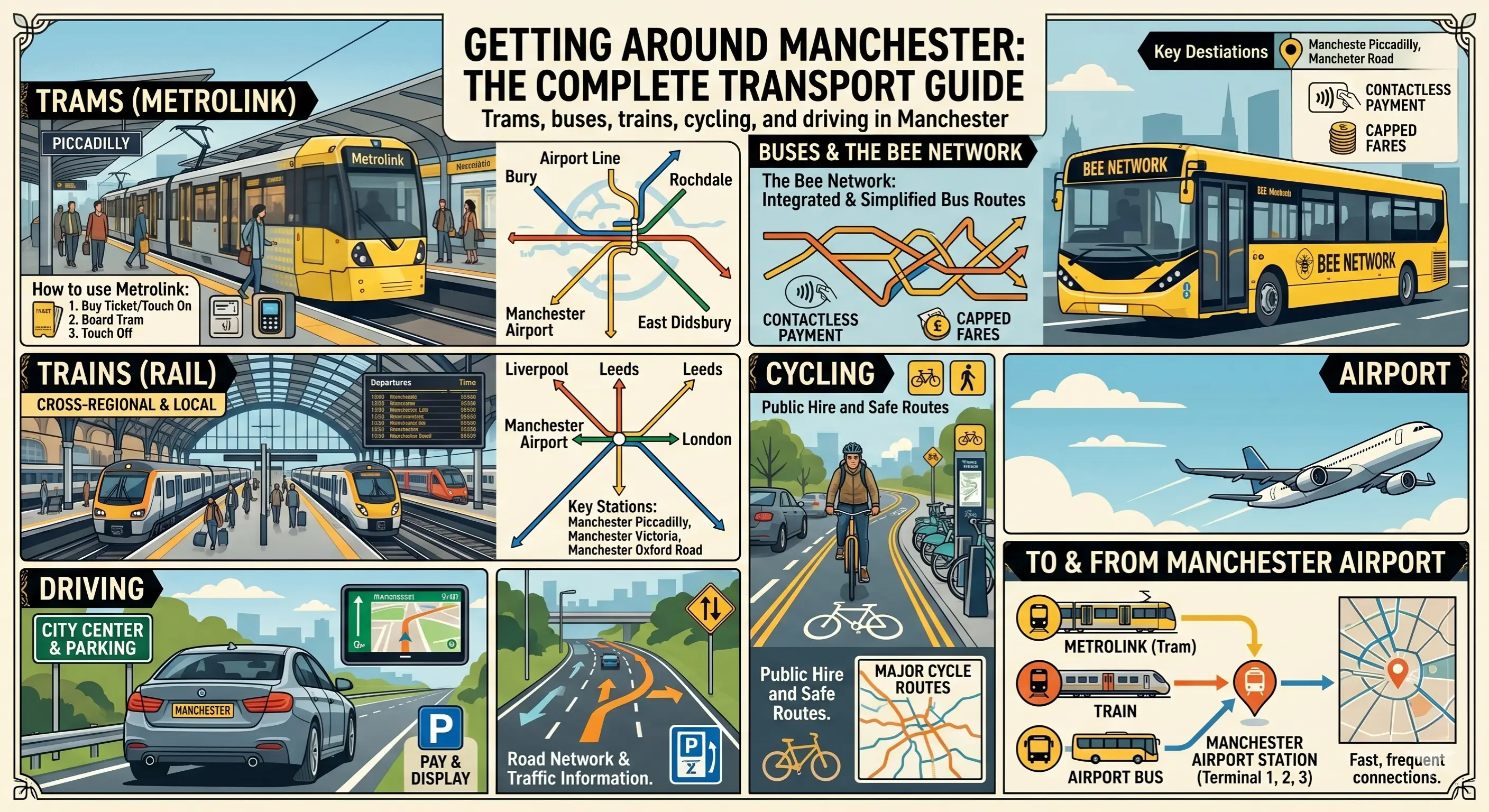
The tram network is the backbone of the whole system, and for most Manchester residents it's the first thing you'll properly get to know. It's the biggest light rail network in the UK, with 99 stops spread across eight lines, covering roughly 64 miles of track.
The lines run out from the city centre to:
Altrincham, south-west, via Sale and Stretford
Bury, north, via Prestwich and Whitefield
Rochdale, north-east, via Oldham
East Didsbury, south, via Chorlton
Manchester Airport, south, via Wythenshawe
Eccles and MediaCityUK, west, taking in the Quays
Ashton-under-Lyne, east, via Droylsden
The Trafford Centre, south-west, via Pomona
In the city centre, the lines weave together, so the big hubs (St Peter's Square, Piccadilly Gardens, Deansgate-Castlefield, Victoria) see trams arriving every couple of minutes in practice. Individual lines run every 15 minutes under the current timetable, which sounds slow until you realise most central stops are served by several lines at once.
Fares use a zone system, with Zone 1 in the city centre and Zone 4 on the outer edges. A single fare for a short hop within the centre is a couple of pounds, while the longest possible journey (for example, Manchester Airport to Rochdale, which crosses all four zones) tops out around six pounds. Manchester Airport to the city centre is about £4.60 one way.
Tips that will save you grief:
Always tap in and tap out with the same card. If you forget to tap out, you'll be charged the maximum fare and you'll feel extremely silly about it.
Under-11s travel free with a paying adult.
The daily cap kicks in automatically. You don't need to buy a day ticket up front.
Avoid 8 to 9am and 5 to 6pm on weekdays if you possibly can. Rush hour on the Metrolink isn't horrific by London standards, but it's not fun either.
Buses: the proper comeback story
The buses are the quiet success of the last couple of years. Until recently, Greater Manchester had a deregulated system where different private operators ran their own routes, their own prices, and their own tickets, and it was a faff. Since the Bee Network rollout, one coordinated operator handles everything under a single yellow-and-black brand, and the improvement has been noticeable.
A single bus fare is £2, capped, wherever you're going within Greater Manchester. A bus-only day ticket is £5. Or you can just tap in and let the daily cap do its thing.
Buses fill the gaps that the trams don't reach, which is most of the interesting bits of the city. Chorlton, Fallowfield, Withington, Levenshulme, Longsight, Moss Side, large chunks of Salford, most of Stockport: if you're heading to any of these, the bus is probably your answer. The 42, the 142, the 143, and the 50 are the ones you'll learn by number whether you want to or not.
Trains: getting out of town
Manchester has two main central stations, and it's worth knowing which is which.
Piccadilly is the big one. This is where you go for London, Birmingham, the airport, most of the south, and most long-distance journeys. It's also the main interchange for local services into Stockport, the Peak District, and onward to Sheffield.
Victoria handles a lot of the services to the north and east. Trains to Leeds, York, Bradford, Rochdale, Todmorden, Clitheroe, and the Calder Valley mostly run from here.
Oxford Road is the smaller third station, tucked into the university district. It mostly handles local services and a bit of cross-city traffic.
Some rough journey times from Piccadilly:
London Euston: around 2 hours
Liverpool Lime Street: around 50 minutes
Leeds: around 50 minutes
York: around 1 hour 20 minutes
Birmingham New Street: around 1 hour 30 minutes
Sheffield: around 55 minutes
Edinburgh: around 3 hours 10 minutes
Tickets are cheapest booked in advance for longer journeys. For local hops within Greater Manchester, combined train and tram tickets are now available, and this will get simpler as rail is folded further into the Bee Network through 2026.
Getting to Manchester Airport
One of the genuinely underrated things about living in Manchester is how easy the airport is. It's inside the city, connected by multiple modes, and flies direct to more than 200 destinations. No five-hour coach trek to get home from holiday.
Your options from the city centre:
Train. The quickest way, running from Piccadilly in roughly 18 to 25 minutes depending on the service. The most obvious choice if you're travelling light.
Metrolink. Takes longer (around 50 minutes from St Peter's Square) but runs from more points around the city, so it's often more convenient if you don't live near Piccadilly. Around £4.60 one way, with proper luggage space on board.
Taxi or Uber. Expect somewhere between £25 and £40 from central Manchester, more in the small hours or during surge pricing. Fine for early morning flights when the trams aren't yet running, or when you're travelling with a family and enough suitcases to fill a small van.
Driving and parking. Possible, but airport parking gets expensive fast. Usually only worth it if you're away for a short trip and the maths works out.
Cycling: quietly improving
Manchester isn't Amsterdam yet, but it's closer than it was five years ago. Protected bike lanes have been creeping across the city, the towpath network is excellent for longer rides, and the terrain is mostly flat enough that you don't need thighs of steel.
The best traffic-free routes, if you're cycling for pleasure or commuting:
The Ashton Canal towpath, running from Ancoats out east through Openshaw towards Stalybridge. A bit rough underwheel in places, but scenic in a gritty Mancunian way.
The Bridgewater Canal towpath, heading south-west from Castlefield towards Sale and Altrincham. Smoother, leafier, and genuinely lovely on a summer evening.
The Fallowfield Loop, a converted railway line that cuts through South Manchester from Chorlton to Fairfield. Eight miles of traffic-free path, flat as a pancake, used by commuters and cargo-bike families alike.
For bike hire, the Beryl scheme runs across central Manchester. You unlock the bikes with an app, ride to your destination, and park at a designated bay. Good for one-off trips or when you've had a drink too many to walk home.
Driving: the honest verdict
You don't need a car in central Manchester. If you live in Ancoats, the Northern Quarter, Deansgate, Castlefield, Hulme, or the city centre proper, a car is more trouble than it's worth. Parking is eye-watering (expect £10 to £20 for a few hours in the centre), many residential streets are permit-only, and you'll spend more time looking for a space than actually driving anywhere useful.
Outside the centre, it's more nuanced. In Chorlton, Didsbury, Altrincham, or Sale, you can live happily without a car if you're willing to plan around public transport, but most households still have one (or share one) for shopping runs, days out, and the bits of Greater Manchester that the trams don't reach.
If you do drive, the good news is that Manchester has genuinely excellent motorway access. The M60 rings the city, and the M62, M56, and M6 branch off it, meaning most of the North West is within easy reach. You can be in the Peak District in 40 minutes, the Lake District in an hour and a half, North Wales in under two hours.
The caveats: check whether your vehicle is affected by the Clean Air Zone rules (older diesels and certain HGVs and taxis may be charged), and be aware that congestion around the M60 between 4pm and 7pm on weekdays is no joke.
The short version
If you're coming from a bigger city, you'll find Manchester genuinely manageable. The trams work. The buses finally make sense. The trains go most places you want to go. The airport is a dream. Cycling is getting better every year, and driving, if you must, is perfectly feasible with the right expectations.
Download the Bee Network app, get a contactless card you can tap without thinking, and you'll pick the rest up within a month. A month after that, you'll be giving directions to tourists like you've lived here forever.