Manchester Slang: The Complete Mancunian Dictionary
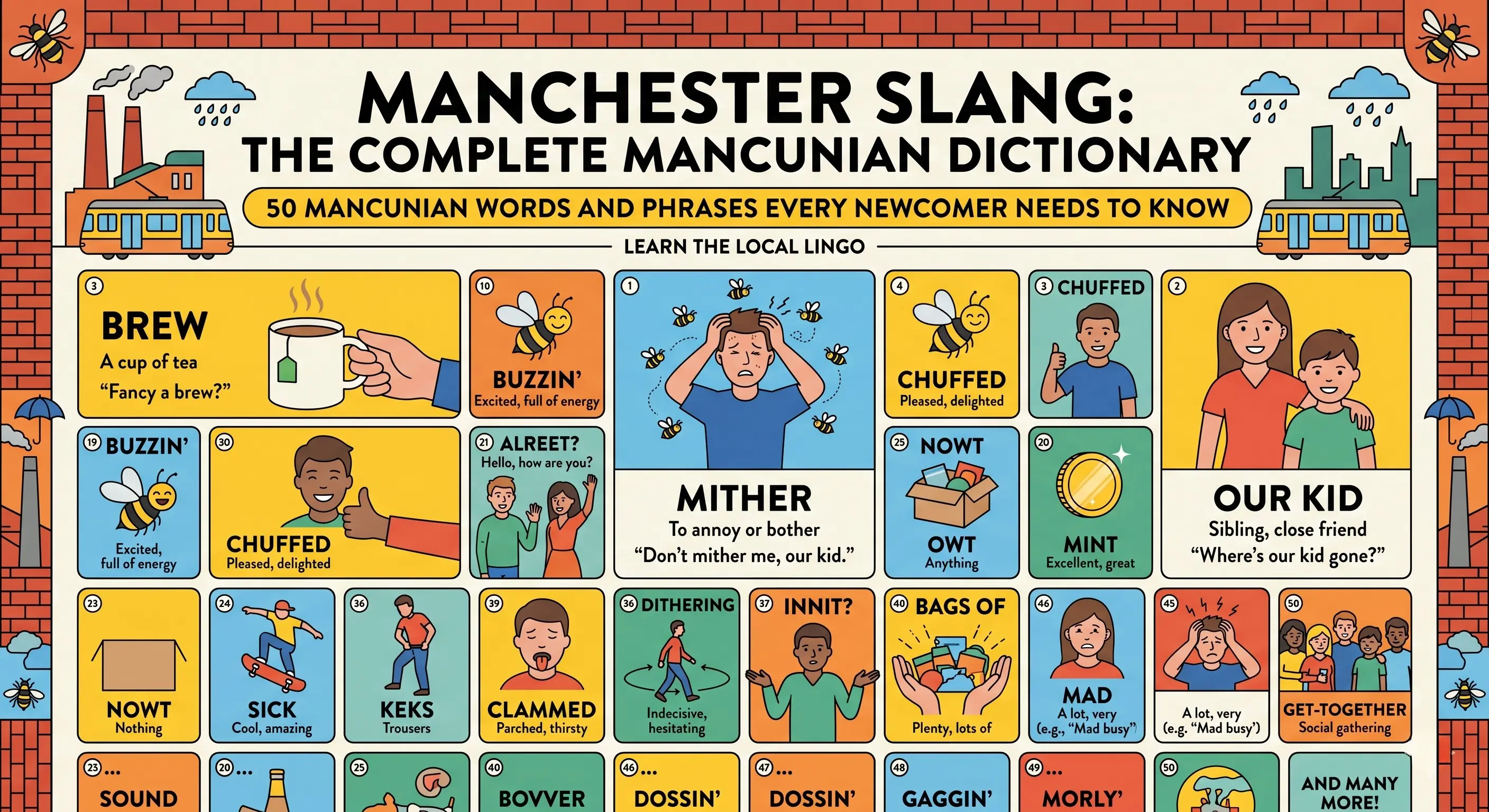
Around 30 Mancunian words and phrases every newcomer needs to know. From "mither" to "our kid" to "brew". Learn the local lingo before you get caught out at the chippy.

On this page(7)
So you've moved to Manchester. Or you're thinking about it. Or you've been here six months and you're still nodding politely when someone says something you didn't quite catch. Whichever camp you're in, welcome. You'll have noticed by now that people here don't just sound different, they use different words entirely. Some you can puzzle out from context. Others will leave you smiling vaguely at a colleague while you try to work out whether you've just been insulted, offered a sandwich, or both.
This is your crib sheet. We've skipped the academic tone and the phonetic spelling nonsense, because you don't need a linguistics degree to order a bacon barm. What you need is to know what the word means, when people actually use it, and how not to sound daft when you give it a go yourself.
A word of warning before we start. Manchester slang is generous. Most of it is warm, a lot of it is funny, and almost none of it is precious about being used "correctly". Nobody's going to put you on trial for getting it slightly wrong. But a few of these words carry real regional weight, and using them badly can sound like you're doing an impression. So read, listen, and ease into it.
The everyday essentials
If you only learn five Manchester words, make them these. You'll hear them on the bus, at work, in the pub, at the corner shop, and halfway through every conversation that lasts more than three minutes.
Sound. The most useful word in the entire Mancunian vocabulary. It means good, fine, agreed, no problem, and about twelve other things depending on how you say it. "I'll see you at seven." "Sound." "He's a sound lad, you'll like him." "Is that alright with you?" "Yeah, sound." Once you start listening for it, you'll hear it roughly every ninety seconds. Start using it yourself and you've basically passed the entrance exam.
Mint. Excellent. Used for gigs, meals, holidays, jackets, anything that's genuinely brilliant. "That curry was mint." Interchangeable with "belter", though "mint" feels a bit more casual and "belter" has a celebratory ring to it.
Belter. Also excellent, but with feeling. A belter is a thing so good it deserves a drumroll. "That gig was an absolute belter." Usually preceded by "absolute", because understatement has never been Manchester's strong suit.
Dead. Very. The city's universal intensifier. "This curry is dead spicy." "She's dead clever." "It's dead easy." Grammatically it doesn't make any sense, and that's part of the charm. You can put "dead" in front of almost any adjective and it'll sound right.
Made up. Pleased. Delighted. Chuffed, if you prefer the Yorkshire equivalent. "I'm made up for him, he deserves it." It's the standard Manchester way of expressing genuine happiness for someone, and it carries more warmth than "happy" or "glad" ever manage.
People, and who's who
Manchester has a whole cast of characters, and the words for them matter because they tell you how familiar someone's being with you.
Lad. A guy. Used very loosely, and not always referring to someone young. A fifty-year-old mate of your dad's can still be a "sound lad". The word carries affection more than age.
Cock. A term of endearment. Completely platonic, usually used by older Mancunians, and absolutely nothing to do with anything rude. "Alright, cock?" is how a market trader might greet you on a Tuesday morning. If a woman of a certain age calls you "cock" while handing you your change, you've been blessed.
Our kid. Your brother or sister, or sometimes a very close friend who may as well be. "I went round to our kid's gaff." It's one of the most distinctly Mancunian phrases in existence, immortalised by the Gallagher brothers and used without irony all over Greater Manchester. Don't try to use it about someone you've just met. It's earned, not given.
How you're feeling (and how everyone else is, mostly)
There's a whole subcategory of Manchester slang devoted to emotional states, particularly the grumpy ones. You'll find this comes in handy more often than you might expect.
Mardy. Sulky, grumpy, in a strop. "Don't be so mardy." Usually aimed at someone who's being a bit precious about something. Can also apply to children, weather, and moods.
Cob on. To be visibly annoyed. "What's up with him? He's got a right cob on." The phrase is lovely because it implies the mood is sitting on the person like a lump of something heavy. You don't just have a cob on, you wear it.
Knackered. Exhausted. Beyond tired. "I'm knackered, I'm off to bed." Used by everyone from builders to grandmothers. Perfectly polite in any company.
Hanging. Hungover, or feeling generally rough. "I'm absolutely hanging today." Usually delivered with a slight wince and a coffee. If someone texts you "hanging" at 10am on a Sunday, don't expect brunch.
Hooped. Very drunk. "He was hooped by 9pm." A useful step up from "merry" or "tipsy", implying the person is no longer steering their own evening.
Nesh. Soft, particularly about the cold. If you're shivering in a light jumper when it's only ten degrees out, someone will call you nesh. It's half insult, half affection, and completely Northern. You will hear it the first time you complain about the weather.
Food and drink, and the confusion around them
This section requires special attention, because Manchester's approach to meal times genuinely baffles outsiders. Settle in.
Brew. A cup of tea. Always tea, unless someone specifically says otherwise. "Stick the kettle on, I'll have a brew." Offering someone a brew is one of the defining rituals of Manchester life. Refusing one is permitted but notable.
Tea. The evening meal. Yes, really. "What you having for your tea?" does not mean "what kind of tea are you drinking", it means "what's for dinner". This catches every single Southerner out, every single time.
Dinner. The midday meal. Also known elsewhere as lunch. So in Manchester, you have your dinner at lunchtime and your tea at dinnertime. This will confuse you for roughly six months, and then one day you'll say "I had a sandwich for my dinner" without thinking, and you'll know something in your brain has shifted.
Barm, or barm cake. A bread roll. Not a bun. Not a bap. Not a cob, a muffin, or a stottie. In Manchester, it's a barm, the argument is settled, and any other term will get you gentle but firm correction. "I'll have a bacon barm, please." The word sounds a bit odd at first. You'll get used to it.
Sarnie. A sandwich. Any sandwich. "I'll have a chip sarnie." (A chip sarnie, for what it's worth, is chips in a buttered barm, and it is exactly as good as it sounds.)
Scran. Food in general. "What's the scran like at this place?" is a perfectly normal way to ask whether a restaurant's any good. It's useful because it covers everything from a Michelin-starred tasting menu to a kebab at 2am, without judgement.
Your stuff and your space
A few quick ones for the everyday objects in your life.
Gaff. Your house, flat, or wherever you're kipping. "We're meeting at his gaff first." Works for any kind of home, from a rented studio in Hulme to a semi in Didsbury. Classless, ageless, endlessly useful.
Kecks. Trousers. Also used occasionally for underwear, depending on the speaker and the context, so tread carefully. "You can't go out in those kecks" almost always means trousers, though.
Loaf. Your head. Specifically, the bit that's supposed to contain your brain. "Use your loaf!" is the classic Mancunian nudge towards common sense, usually directed at someone who has just done something mildly stupid.
The little connectors
These are the small words that thread through everyday speech. They're not flashy, but once you start using them, your sentences will sound more local without you having to try.
Nowt. Nothing. "There's nowt on telly." Pronounced to rhyme with "out". Paired endlessly with its sibling, owt.
Owt. Anything. "You want owt from the shop?" If someone asks this and you say "nowt", you're halfway to sounding like a lifer.
Gander. A look. "Have a gander at this." Always a quick, curious, slightly nosy look. You don't have a gander at a sunset, you have a gander at your neighbour's new car.
Crack on. Get on with it. "Right, I'll crack on then." Polite, cheerful, and a reliable way to signal you're going back to work without being rude about the conversation ending.
Pack it in. Stop it. "Pack it in, the pair of you." Directed at children, drunk mates, and anyone being tiresome. Carries a firm but affectionate tone, at least most of the time.
Mither. To bother, pester, or annoy. "Stop mithering me, I'll sort it later." One of the most distinctively Mancunian words on this entire list. You can be mithered by a colleague, a child, a wasp, or a nagging worry. It's beautifully flexible, and almost impossible to fake if you didn't grow up with it.
Parky. Cold, specifically about the weather. "It's a bit parky out." You will use this word more than you expect, because it is genuinely parky in Manchester more often than not.
A note on the accent
Here's the thing. Manchester slang doesn't quite work without the Manchester accent, and the Manchester accent is harder to fake than it sounds. The vowels are flat. The "u" in "but" is the same as the "u" in "put". The "th" at the start of "the" sometimes softens into a "d" in fast speech. And most people here quietly swallow the "h" at the start of words, so "house" becomes "'ouse" without anyone noticing they're doing it.
Don't panic about getting the accent right. Nobody expects you to. You'll pick up the rhythm of the place just by being in it, and the words will start appearing in your speech before you've decided they should. One day you'll offer a mate a brew and call them "cock" without meaning to, and that's when you'll know you've properly arrived.
If you want to hear Manchester English at its purest, there are a few reliable places to go. Any interview with Liam Gallagher will give you the exaggerated version. Caroline Aherne's writing, particularly The Royle Family, gives you the rhythms of everyday Mancunian speech better than almost anything ever filmed. And Mark E. Smith, bless him, is a masterclass in the flatness of the vowels, though you might need subtitles for the rest.
Or, you know, just spend a week in any pub in Levenshulme. It's cheaper than a linguistics course and the scran's usually better, too.