The Manchester Property Guide (2026)
House prices, rental costs, market trends, and where to buy in Manchester in 2026. A proper neighbourhood-by-neighbourhood look at what the market actually looks like right now.

On this page(6)
If you're trying to get a handle on the Manchester property market in 2026, you've picked an interesting moment. Prices are still rising, rents are still rising, and demand in the desirable postcodes continues to outpace anything the housebuilders can actually deliver. But the pace isn't quite what it was at the peak of the pandemic boom, and different neighbourhoods are moving at very different speeds. This guide will walk you through the whole picture: the headline numbers, what things actually cost on the ground, what's driving the market, the areas worth keeping an eye on, and the practical bits nobody thinks to tell you until you're already knee-deep in a mortgage application.
A quick note before we start. This is a guide, not financial advice. Property is a big decision and everyone's circumstances are different. The prices below are a solid snapshot of early 2026, but they'll shift, so treat them as a directional guide and check live listings before you commit to anything.
The headline numbers
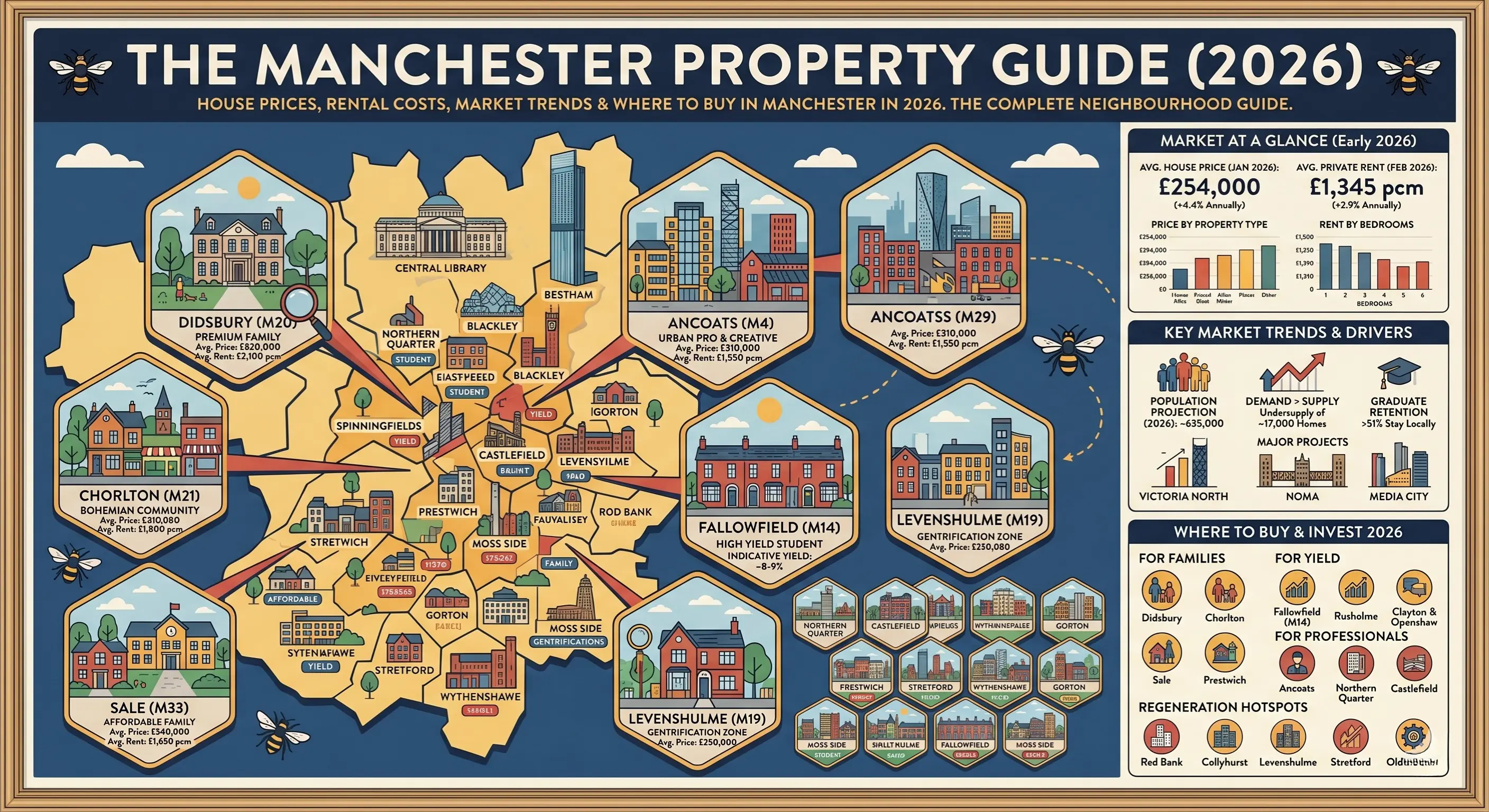
According to the Office for National Statistics, the average house price in Manchester in January 2026 was £254,000, up 4.4% from a year earlier. That's comfortably ahead of the North West average (3.1% growth) and well ahead of the UK as a whole (1.3%). Manchester continues to be one of the fastest-growing property markets in the country by percentage, even if the absolute prices still look reasonable next to London.
On the rental side, the average monthly private rent in Manchester hit £1,345 in February 2026, compared to a UK average of £1,374 and a North West average of just £944. That gap between Manchester and the rest of the region tells you most of what you need to know about demand in the city proper. Manchester now rents at almost London-adjacent rates, despite house prices that are less than half of the capital's.
Two more numbers worth keeping in your head. First, about 62% of Manchester households rent rather than own, which is one of the highest rates in England. Second, average rental yields for landlords sit somewhere in the 5.5% to 6.5% range, noticeably higher than most of the UK, which is why the city has become such a magnet for buy-to-let investors.
Those averages hide enormous variation, though. The most expensive Manchester neighbourhoods (Didsbury, the cluster around Bowdon and Hale, premium new-build apartments in the city core) can routinely sell homes at three to five times the city average. The cheapest corners of the city are still moving homes well below £150,000. You're not really buying into "Manchester" when you buy here. You're buying into a specific neighbourhood, and the neighbourhoods are very different animals.
What a home actually costs, by area
These are rough 2026 ranges, drawn from current listings and recent sold prices. Real-world numbers will vary based on condition, exact street, and the mood of the market on any given month.
Didsbury. The classic leafy South Manchester choice, especially for families. One-bed flats sit roughly in the £200k to £280k range. Three-bed family houses typically run £500k to £750k, and the top end of the market (big Victorian villas in West Didsbury) can push north of £1.5m.
Chorlton. A touch more bohemian than Didsbury, and a bit cheaper for equivalent space. One-bed flats around £180k to £250k, three-bed houses £450k to £650k, and the prettiest period houses topping out around £1.2m.
Altrincham. Technically in Trafford rather than Manchester proper, but often grouped in the same conversation. Strong schools, good transport, and prices to match. One-bed flats £160k to £230k, family houses £450k to £700k, with the mansions around Bowdon and Hale stretching towards £2m and beyond.
Sale. Altrincham's slightly more affordable neighbour. One-bed flats £150k to £210k, three-bed houses £350k to £550k. Popular with families priced out of Altrincham who still want the same tram line.
Northern Quarter. City-centre living at a premium. Almost entirely flats. One-beds run £200k to £330k, with the nicest warehouse conversions pushing higher. No gardens, no parking, but you're in the middle of everything.
Ancoats. The former industrial district that has reinvented itself as one of the most desirable postcodes in the city. One-bed flats £230k to £330k, two-beds £450k+, and a steady pipeline of new developments that keep the market active.
Salford Quays. Mostly flats, mostly riverside or dockside, mostly modern. One-bed flats £180k to £250k, with the premium towers going considerably higher.
Stockport. Technically its own borough, but the town centre regeneration has made it one of the most-talked-about comeback stories in Greater Manchester. One-bed flats £130k to £190k, three-bed houses £250k to £450k.
Levenshulme. The poster child for South Manchester gentrification over the past decade. Three-bed terraces and semis typically £280k to £450k, with strong growth in recent years.
Prestwich. North of the city, Metrolink-connected, increasingly popular. Three-bed houses £350k to £550k.
If you're buying, the rough rule is that anything within the M60 ring with decent tram access carries a premium. Step outside the ring, or rely on buses instead of trams, and you'll get meaningfully more space for your money.
What's driving prices
A few fundamentals underpin the whole market, and they've been pulling in the same direction for a while.
Population growth. Manchester's population grew by 9.7% between 2011 and 2021, to around 552,000. That's the third-fastest growth rate in the North West, and Manchester remains one of the fastest-growing big cities in England. More people means more demand, and the housebuilders haven't kept up.
Limited supply. The city needs somewhere in the region of 5,000 to 7,000 new homes a year to keep up with demand, depending on who you ask. Actual delivery has averaged closer to 2,000 to 4,500 homes annually over the past decade. The maths is pretty simple, and not in buyers' favour.
Regeneration investment. The Victoria North programme, a £4 billion project to deliver around 15,000 new homes across Collyhurst, Red Bank, and the northern edge of the city centre, is probably the biggest single piece of regeneration happening in the UK outside London. Add to that the ongoing build-out of Mayfield near Piccadilly, the Great Jackson Street towers, Pomona Island, and various Salford schemes, and the scale of investment is substantial.
The job market. Manchester has become the UK's biggest tech hub outside London, and a serious banking, legal, and media centre in its own right. Employer relocations from London and the continued growth of MediaCityUK, Circle Square, and the Oxford Road Corridor have brought tens of thousands of well-paid jobs into the city. That feeds demand at every price point.
Transport improvements. The Metrolink has been extending in fits and starts for twenty years, and planned rail investment will continue to reshape where people feel comfortable living. Areas that are currently a bit awkward to get to from the centre often see noticeable price lifts once a new tram link arrives.
Areas worth watching in 2026
A few of the places where the market dynamics look particularly interesting right now. Standard caveat applies: "areas to watch" is not a guarantee of anything, and nothing here is a tip to buy.
Ancoats and New Islington. Continued strong annual price growth, sustained demand from young professionals, and a thin pipeline of genuinely new apartments coming onto the market. The downside is you're paying close to the top of the Manchester price-per-square-foot curve.
Levenshulme. Has had one of the most dramatic transformations of any Manchester neighbourhood over the past decade, as buyers priced out of Chorlton and Didsbury moved east. Still offers more house for your money than its South Manchester neighbours, though the arbitrage has narrowed.
Stockport. Town centre redevelopment has turned what used to be the discount option for priced-out commuters into a genuine destination. New apartments, new public space, a growing food and drink scene, and decent train connectivity into central Manchester.
Victoria North (Collyhurst, Red Bank). The £4 billion regeneration project is at its early stages. Parts of the area are still visibly rough, and will be for several years. If the scheme delivers as planned, early buyers may see significant uplift. If it stalls or gets descoped, they might not. Long-term bet, not a short one.
Practical things to know before you buy
A handful of things that catch newcomers out.
Days on market. Typical properties sit for around 45 to 65 days in the current market. Well-presented family homes in the popular South Manchester neighbourhoods (Didsbury, Chorlton, parts of Altrincham) can and do sell inside a week, sometimes with multiple sealed bids.
Negotiation. Buyers typically land somewhere between the asking price and 7% below it, depending on the property and the market. Premium homes in the hottest areas often sell at or above asking. Flats in over-supplied city-centre markets tend to have more negotiation room.
Flats vs houses. Apartments make up roughly 55% of all listings in Manchester, which is a much higher share than in most UK cities. If you want a house with a garden, you'll generally need to look outside the city centre.
Service charges. New-build flats in central Manchester often come with service charges of £2,000 to £5,000+ per year, sometimes more in the towers with concierge and gym facilities. Budget for these carefully. They can change the real cost of ownership substantially.
Leasehold. Most flats, and a surprising number of houses in some developments, are leasehold rather than freehold. Read the terms carefully, particularly around ground rents and lease length, and get a solicitor who knows the Manchester market to review anything complicated.
Cladding and EWS1. Some Manchester apartment blocks have had significant issues with cladding remediation since 2017. The situation has improved considerably, but it's still worth asking any seller or developer for the current EWS1 status on the building before you exchange.
The short version
Manchester in 2026 is still a seller's market in most of the desirable neighbourhoods, still a landlord's market almost everywhere, and still one of the most interesting property markets in the UK by almost any measure. Prices are rising, but from a base that remains reasonable by national standards. Rents are high but still make sense for the income profile of the city.
If you're buying, move carefully in the hot areas and do proper due diligence on new-build flats. If you're renting, start looking three to four weeks before you need to move, and don't expect to find bargains in Chorlton, Didsbury, or Ancoats. If you're investing, the yields still work, but only if you pick the right property in the right street, and the overall returns are far more about income than quick capital gains.
And as ever, nothing in this guide is financial advice. Talk to a mortgage broker, a solicitor, and ideally someone who already lives in the neighbourhood you're eyeing up, before you make any decisions you can't easily unwind.