'Manchester shouldn't be a business plan, it should be a work of art': can the city grow without losing its soul?
Business leaders gathered at the Co-operative Bank to debate whether the global spotlight on Manchester is reaching all 10 boroughs. The answer? Not yet, but "swagger" without arrogance could be the key.
On this page(3)
Soul? Swagger? Togetherness? Even (whisper it quietly) Manchesterism? Call it what you like, but business leaders say there is something in Manchester that is different, and the challenge now is making sure it works for everyone.
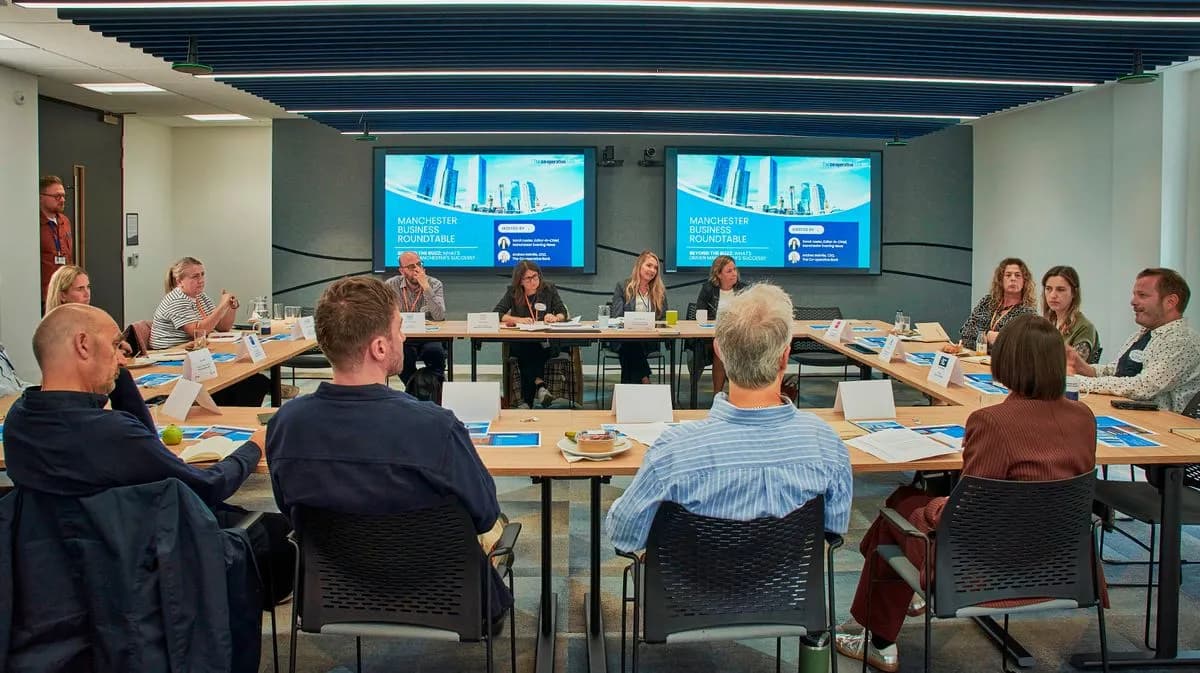
MEN editor Sarah Lester joined forces with Co-operative Bank boss Andrea Melville this week to bring business leaders together at the bank's Balloon Street headquarters to discuss how real the "buzz" around Manchester actually is, and what it might mean for families in Oldham or Rochdale as well as in the city centre.
One comment from the panel cut through: "Manchester shouldn't be a business plan, it should be a work of art."
What is Manchester's 'soul'?
Mark Beaumont, chief creative officer at Manchester agency Dinosaur, said "soul" was a better word than "Manchesterism" or "brand Manchester."
"We're talking about the essence of what makes the people of this conurbation who they are, and how they tick, and how they move forward into partnerships, relationships, businesses, collaborative connectedness," he said.
He traced the city centre's transformation over 40 years: "From a period where, if you looked down a side street, there were no lights on. Now every side street is lit, there's a café, there's a bar, there's a business, people feel safe."
But, he warned: "Some people aren't doing quite as well as that picture makes out. A lot of people who lived in those boroughs made the centre what it was. People from Salford, people from Prestwich, people from wherever. We have to make that work for the people who aren't seeing the advantage at the moment."
Is the growth reaching all 10 boroughs?
Emma Holt, CEO of the Greater Manchester Chamber of Commerce, said: "We should be encouraged by the great interest there's been in Greater Manchester. That's reflected in the level of foreign direct investment and the interest of people that want to move and live here. We want to spread that across the boroughs."
Melville said: "There is a huge amount of character and benefit that comes from independents. That's what makes areas unique. That's what joins communities and societies together. We need to find ways to support them more."
What about Number 10 North?
The panel agreed it should boost the region further. Moving government functions to Manchester, they heard, can "simply break the deadlock" by forcing the civil service to listen to the world outside London.
One panellist recalled the early 1980s, when someone with a north Manchester accent would be told to take elocution lessons. Now Manchester is known as a cultural powerhouse. The fact that some people are dismayed by Number 10 North, another speaker said, is "a sign that it is important."
One line captured the mood: "Big enough to change the world but small enough to get to grips with it."
Melville closed with: "One of my favourite words is 'swagger.' There's no arrogance to it, but there is a quiet confidence. I think Manchester definitely exhibits that."
Frequently Asked Questions
- What is Number 10 North?
- It refers to the ongoing relocation of civil service and government roles from London to Manchester, aiming to decentralise power and boost the regional economy.
- Why are business leaders concerned about Manchester's growth?
- While welcoming investment, leaders want to ensure the city's rapid development does not erase its unique cultural identity and that wealth reaches all ten boroughs, not just the centre.
- Who hosted the recent Manchester business roundtable?
- The event was jointly hosted by the Manchester Evening News and the Co-operative Bank to discuss the region's economic and cultural future.